Music recording technology never really evolved past the CD. A few weeks ago, I had the chance to peruse the offerings at a second-hand music store, and I ended up buying a few CDs, and now I’m getting back into them a bit after scuttling my entire collection about fifteen years ago and just ripping all of them to flac. I still have all of those flac files, too, but when I was in the music store, I guess I sort of missed browsing through the media. Vinyl is back bigger than ever, by the way. I monkeyed around with vinyl for many years, and I had some interesting turntables, especially a NAD table, but my favorite one was this direct drive and fully automatic Onkyo. Records are fun, but they have some serious drawbacks that made me start to question if it was worth the time and money. For one, records are dust magnets, and you can brush and brush them, spray them down with all sorts of cleaners and chemicals, and you still get dust, and that turns into pops on the record. For two, they are bulky and heavy. For three, they don’t sound good anyway especially compared to a CD with a good DAC setup. It’s not even close.
It’s just kind of weird that if one wants to get into physical media nowadays, the best option is still a technology that’s been around since 1982. There were attempts to move beyond that with DVD-Audio and SACD, but those never caught on, and the culture shifted to MP3s and streaming. My flac files are as good as they ever were, in terms of what’s out there. Music is still sold as MP3 on Amazon, with no better option, and MP3 really does suck compared to CD. I noticed it the other day in the car, the album I was listening to, which in this case was Colors by Beck, kept revealing little details, so much so I perked up and noticed it. Twangier guitar strings, more background noise, more detail in the voices. It’s a real thing.
I’ve watched all of this unfold in my lifetime. When I was a kid, my dad saved up and bought himself a nice hi-fi system, and I remember waking up on weekend mornings to Billy Joel pumping throughout the house. His setup was good by any measure. He had a couple of AR tower speakers, which I kept for many years before I let them go, a nice Dual turntable. Then it was cassettes, which are worse than vinyl, their only virtue being their portability, and then in the mid 1980s the CD came onto the scene. I had one of those mini stereo systems in my room, and it must have had RCA inputs, because I saved my money and my dad took me to Rex, which was an electronics retailer here back then, and I bought a Sharp CD player. I believe it was model DX-677, but I can’t be completely sure.
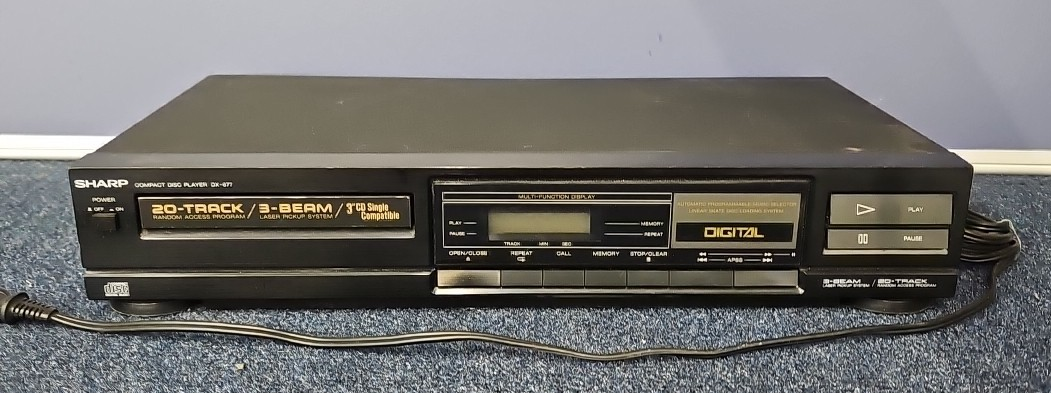
It was awesome. It was snappy, had this great orange-glow LCD display, and get this: It could skip tracks. My first CDs were Cosmic Thing by the B-52s, and Poison by Bel Biv DeVoe, so this all would have occurred during the year 1990, I think, and it isn’t a coincidence that I was able to afford a CD player in 1990. That’s when CD players became popular and affordable enough that most people could buy one. I decided to see if my old player was available on Ebay, and it was, easily, and that led me to spend several days on Ebay researching the vintage CD player market.
The first generation players are hard to come by, and finding one in decent shape is harder, still. These are from a few players like Sony, Philips, and Technics. These tend to be boxy with simple dot matrix displays, and I would suppose they were very expensive and not very good in terms of audio quality. These were released from approximately 1982-1985. Around 1986, you start to see the early second-generation models, which are built with plastic facia and buttons and appear more mass-market and less niche, and almost all of them are still made in Japan. Sony is by far the most dominant manufacturer, then Denon, Yamaha, Onkyo, Sharp, Technics, Teac, Panasonic, JVC, Kenwood, but also older names that were bigger during the 60s and 70s with their turntables, such as Garrard, Fisher, Sansui, and a few others. I was surprised to find a Garrard CD player from the second generation, for instance.
The second generation goes from about 1986-1991 give or take, and my Sharp DX-677 was a single-DAC mass-market player bought during the explosion of the CD. When I was researching them, I found that the DX-200 and the DX-R250 use the same chassis, but these models have two DACs, making them the most desireable units of the Sharp second-generation Japanese-made players. The best price I found on one of these models was $69 shipped, advertised as working, so I pulled the trigger on it. I’m eager to be re-united with my old unit.
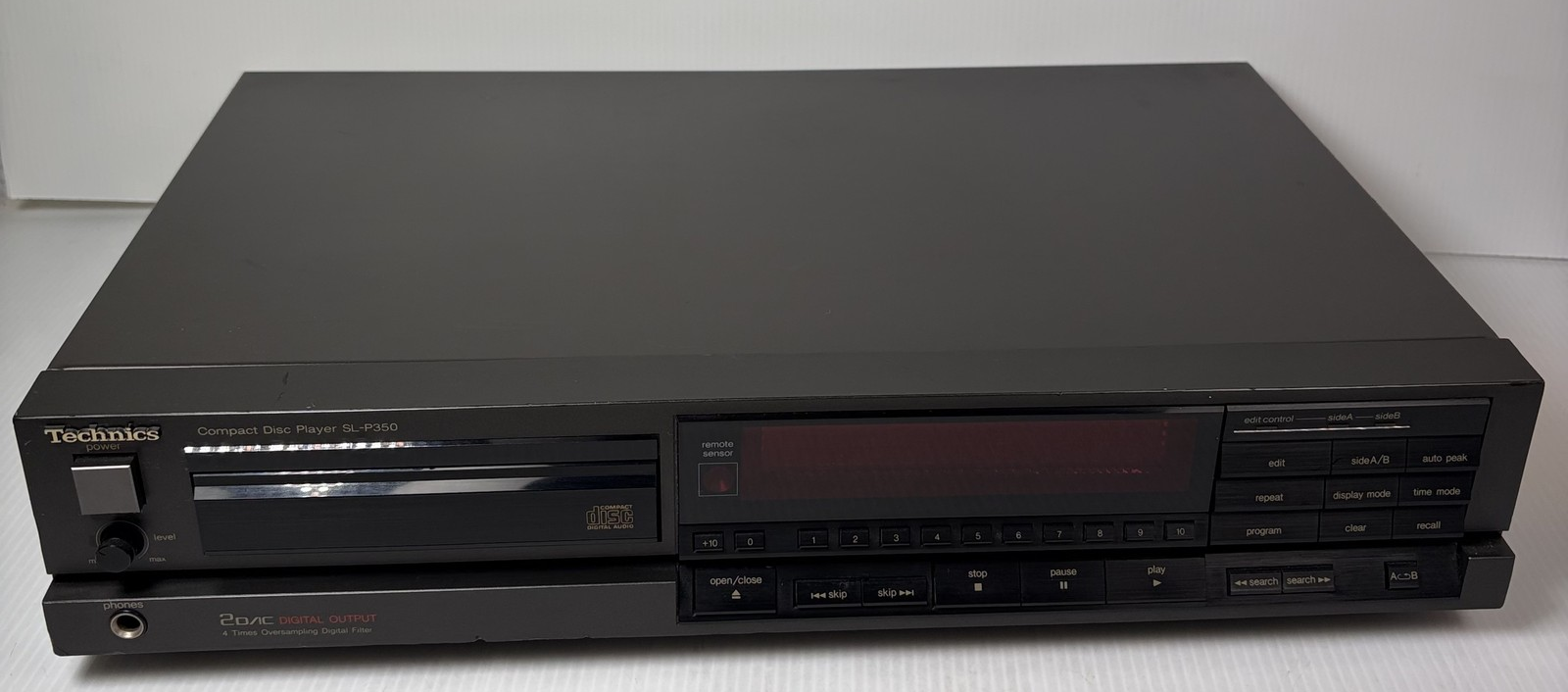
Sharp doesn’t make it into the third generation of players. By then, it is all Sony, Yamaha, Onkyo, Teac, JVC, Denon, Panasonic, and every manufacturer moves away from the single-disk player to the multi-disc carousel-type players. It is here that you can pick up a carousel for $60-$100 easily, often with optical out, so you could use it as just a transport and pass the singal through to a dedicated DAC or a receiver. This feature is harder to find in the single-disk players from the second-generation, but they do exist. Digital out goes back to at least 1982, which surprised me a little. That puts single-disc players of the second generation with digital out into my highly desireable category, and some of these are the Onkyo DX-2500, Denon DCD-1500, and Technics SL-P350. These go for $100-$400 or so on the used market.
Of course, the CD, combined with the PC gaining an optical drive meant that ripping and compressing the track was something anyone could do, and the compressed track enabled people to share the tracks using Napster or Bearshare or Limewire. I remember back then trying to assemble albums song-by-song using Bearshare over a dialup connection. Then bittorrent came out, and then broadband, and we were off to the races. Today, one can easily download entire albums in pristine flac format, but interested again is that the format hasn’t really changed. Flac doing 16-bit, 44.1 khz. is still the best quality available, aside from some high definition stuff you find here and there, so the CD is still quite relevant and collectible.
If you want to buy a new CD player, you don’t have all that many options, and you don’t have any good affordable options. Onkyo makes a more mass-market type carousel player that sells for around $300, so that’s still pretty expensive. I think Teac and Yamaha still makes them, too, but these are all expensive and aimed at more niche audiophile types of buyers. On Amazon, you just find little chinzy players, for the most part, not the component players of the past, so inevitably one will look at the used market to find a deal.